Posts

Showing posts with the label materials

IKEA school supply storage.

Image
Next year I will be in my new classroom and the space for desks is a little tighter than my previous classroom so I had to come up with some creative ways to organize classroom supplies. Where do I love to find organizing stuff? IKEA! The closest IKEA to my house is an hour and a half away in Burlington Ontario but I love that store so much that I do not mind the drive.  This was my latest project from IKEA. I installed the Bygel rails ($2.99 each Canadian) and white Bygel containers (99 cents each Canadian).  You can see them on the website at these addresses Rails: http://m.ikea.com/ca/en/catalog/products/art/50072645/ Containers: http://m.ikea.com/ca/en/catalog/products/art/10271091/ You can get the containers in different colors but I personally like a more uncluttered and less distracting look in the classroom.  I also installed the "focus" letters on the wall. I bought these at Hobby Lobby for $3 each and used command strips t...

3c: Engaging Students in Learning and 1b: Demonstrating Knowledge of Students with Protein model made from a baby toy

Image
Continuing with the theme... In my last post I showed a blood model that I use to help my students understand that oxygenated blood tends to be a red color and deoxygenated blood tends to have a deep red color with the blood model. blood models Here is another way I use simple materials to demonstrate a concept to my students. I use baby pop-it beads to show the relationship between amino acids and proteins.     Each bead represents an amino acid (I wrote the names of different amino acids on each in permanent marker) and a long chain of them represents a protein.     I keep my eyes pealed for these babies at garage sales because eventually someday I would like to have so many "amino acids" that I can make a protein chain that is long enough to twist and make a shape that would be a better representative of a protein's tertiary structure. What do you use as models in your class? originally posted on ballinwithballing.blogsp...

3c: Engaging Students in Learning with a model of DNA, chromosomes, genes, and nucleus

Image
     Often teachers find everyday materials and find a new way to use them in the classroom. It's a part of the job that sticks with you and even in the summer I see items in a new way and try to find new ways to help my students learn difficult concepts.  I have noticed that even retired teachers can't turn their brains off and even though they may not have a class anymore they still continue to look for new materials for the classroom. Here is one of my examples from my classroom: skein of yarn (AKA: Chromosome) it might look like a skein of yarn to you...but to a biology teacher (like myself) and to my students it represents a chromosome. Because it is just like DNA that has been all coiled up and packaged so that it is easy to move in the cell.      Could you imagine if they sold yarn uncoiled in the store like this? Uncoiled yarn (AKA: DNA in the cell in Interphase) Yarn uncolied a...

3b: Using Questioning and Discussion Techniques with The Fast Five

Image
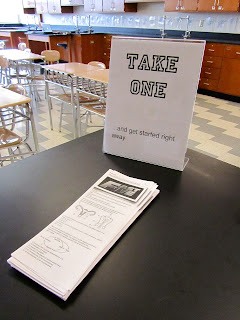
     The class I teach is a New York State Biology course called "The Living Environment." At the end of the year all students need to pass the New York State exam known as the "Regents Exam". In order to get my students ready for the exam it is imperitive that they become accustomed to the types of questions that they will see on that exam. Often the Regents Exam questions are at a higher level in Bloom's Taxonomy than just simple knowledge. Often the students will be expected to apply their knowledge to articles, experiments, diagrams, etc.      I find that if I do too many practice questions with them they don't try very hard and it takes a large chunk of time. So I've started creating what I call "Fast Fives." At least once a week my students will see a Fast Five on the table when they come into class. They will start working on the questions immediately. The students who get to class earlier have a little more time for the fast ...

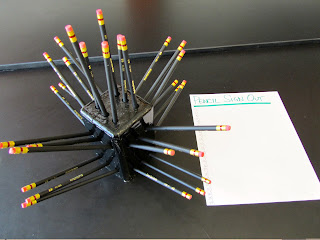
2c: Managing Classroom Procedures and Materials with a "Pencil Tree"

Image
How often do you loan students a pencil and never see it again? Every time I give the students a test I loan them a pencil from the "Pencil Tree" Pencil tree and sign out sheet the student signs out the pencil and crosses their name off when it is returned. By storing the pencils in the "Tree." missing pencils all pencils returned! By the way...my students love that they have Mirado Black Warrior pencils to use...they just love the name and it's easy to see if it is my pencil or theirs. You can buy Mirado Black Warriors by clicking on the image here:  I can quickly look and see if all were returned. It saves class time and I never lose a pencil!  This post originally featured on ballinwithballing.blogspot.com